Friday, September 13, 2013

My Foot is Too Big for the Glass Slipper by Gabrielle Reece with Karen Karbo


My Foot is Too big for the Glass Slipper: A guide to the less than perfect life
By Gabrielle Reece with Karen Karbo
When I picked up this book, the title caught me.  I started reading and it all sounded a little too wonderful.  I started to think maybe it was going to be like a reality TV show. Then I was struck by her sense of humor.

“We didn’t even make it to the fifth anniversary before our sexy fairy tale turned into one of those unwatchable Swedish domestic dramas that makes the audience want to throw themselves off the nearest bridge.”
For those who don’t know, Gabrielle Reece is a six-foot-three professional athlete and looking at pictures, you might think she is perfect but she candidly lets you know that she is a real person.

“My arms and legs are so long, sometimes it feels as if I have twice as many moving parts as the average woman... In a few minutes I’ll stand up from the chair I’m sitting in as I write this, and there’s no guarantee I won’t trip over my feet between the desk and the door.  It makes me anxious.”
The more I read, the more down-to-Earth it became with great advice for life.  There were many things I’ve learned too that we all need to be reminded of from time to time. 

“I took every slammed cupboard personally… His mood, the one that would make me feel unloved, would be long gone, but I’d still be feeling the sting of it, the injustice.  I’d still be experiencing his mood, long after he was out of it.”
I think that’s pretty normal for a lot of women, and maybe some men too.  She goes on to say that she would never say anything, that she would tread lightly instead of venting herself and getting it out and over.  Of course, after four years, she couldn’t take it anymore.  She filed for divorce.  He tried to talk her out of it but she was done.  Six months later he showed up to pick up his snowboard and she realized she’d made a mistake.

“Laird and I got back together.  For another year or two, we circled each other, unsure.  We were like survivors of some natural disaster, grateful to be alive, but dazed by the wreckage.  The foundation was cracked, the roof had leaks, the windows were smashed out.  Repairs always take longer – and cost more – than you might first imagine.”
They had a couple kids and hit another rough patch but made it through.  She quotes Anne Morrow Lindbergh - “When you love someone, you do not love them all the time, in exactly the same way, from moment to moment.”

I remember reading an article some time back about how men tend to pull back then lean in cyclically in a relationship.  Paradoxically, women then want to lean in when men are pulling back.  It’s hard to just relax. 
“Nothing makes you superficially more happy than the first flushes of love, but in the ever after it’s all about dealing with your lover, with understanding what makes him tick, surviving his crappy moods, and working together, always, to preserve what you’ve got and nurture a deeper, more profound and grounded love into the future.  Happily schmappily.  I don’t think so.”

This book is like a very chatty and level-headed series of blog posts or essays, covering many of the topics that are important to women today as wives, mothers and human beings.  She covers pregnancy, having a baby and motherhood.  She’s an athlete so she devotes some time to talking about working out, the many benefits of exercise and starting/maintaining a fitness regimen.  She talks about the sisterhood of women and creating a supportive group, preferably inter-generational.
God bless her, I think she hits the nail on the head with food and dieting. 

“Don’t do it.  I don’t care if you’re eighty-seven pounds overweight.” 
I can now fully endorse this book.  She adheres to the principle of eating healthy but having the fun food on occasion too.

“When you put something in your mouth, always know why you’re doing it…  if you’re going to eat that triple fudge salty caramel brownie, really eat it.  Stop texting, give it your full attention, lick your fingers, sigh, and moan.  Enjoy the hell out of it.” 
I agree. 

There’s some things I’m not going to touch on here, because it’s just between us girls.  This is some thoroughly modern reading on what it takes to make a marriage work, parent and live a balanced life in this day and age.  I appreciated it.  I hope you will too.
Check out Gabrielle Reece’s blog at http://www.gabriellereece.com

Friday, August 23, 2013

River Inside the River by Gregory Orr


I’ve found another poet and fallen in love with his words.  “You didn’t know about Gregory Orr?” you ask in astonishment.  I hang my head.  No, I didn’t. 

It’s not all spun sugar and gossamer
p. 69

What’s in a poem?  Everything in life and the human heart including “deepest grief and even horror.”

The problem for me in talking about a collection of poems like this is that my brain feels like it has moved into images and feelings.  It’s difficult to convey.  I want to simply read you the poems I read and say, “See?  Isn’t that wonderful?”  Alas, I cannot in a blog so I will try to explain what I loved about this collection.

As with many collections of poetry, so much is conveyed in such a short volume, only 124 pages, and with only the utterly necessary words.  There are not even titles for the individual poems in the second and third sections, just titles for the three sections of the book and within the first section.  I have heard it said that musicians play notes but great musicians play the silence between the notes as well.  Here, there is lots of space and silence to help shape the poems.

In the section titled Eden and After, Orr reimagines Genesis, in poetic form.

To Choose

God planned a static planet
With plants that bore
No offspring - as if
Acts had no consequence.
p. 27

This created different layers of confusion for my mind.  Was it presumptuous or imaginative to put words in God’s mouth and thoughts in his head?  Does he even have or need those things?  Since God is not a human, is it anthropomorphizing him? 

Eve’s feelings on exploring the world she now inhabits are revealed in two poems –

To Go 

Who wouldn’t be alarmed
To see the tulip’s
Fleshy petals
Wilt and fall?

… How it was definitive,
Beyond recall. 
p. 32

To Say/To Save

As she spoke aloud
Each flower’s name
She felt her saying save
p. 46

I’ve been exploring the idea from Joseph Campbell that the infinite is here and now, that if each moment is being, has been and will always have been, then recognizing fixes it in memory and makes it infinite.  I felt like this last poem caught that idea.

The section titled The City of Poetry is the type of poetry I find more comfortable - more words,  images and thoughts, though still spare.

I read page 56 to 57 about the three main difficult passages in his life and how a book of Keats helped Orr get through the third.  I wondered if this was a personal recollection or a character he had created so I went searching and found the following article.  (Yes, he did kill his younger brother in a hunting accident when he was twelve and his mother did die two years later and he was abducted and imprisoned in rural Alabama during the sixties.)  You can read more about Gregory Orr’s poetry and life here -


Impermanence is celebrated in the section titled River Inside the River

Even the things that seem to stand still
Flow slowly into other forms.
p. 93

Comparing a cat to a love-sponge and a dog as a fountain of love seems so apt to me in the poem on page 99.  I love the fluidity of using he and she for the same character/person “the beloved.”  I find that fascinating and I wonder what he meant by it.  It makes me think of how I sometimes imagine God to be either/neither male or female.

And at last, he made me cry on page 111.

First, there was shatter.
Then, aftermath.

Only later and only slowly
We gathered words
Against our loss.

But last was not least,
Last was not least of these.


This book was a wonderful experience.  I hope you take it.

Saturday, July 27, 2013

The Guernsey Literary and Potato Peel Pie Society by Mary Ann Shaffer and Annie Barrows


The Guernsey Literary and Potato Peel Pie Society
By Mary Ann Shaffer and Annie Barrows

When I was a teenager, I really enjoyed writing letters - long newsy letters with quotes from movies, television, books and songs, mostly to my grandmother and a few friends who lived some distance away.  The letters this story is told in are similar, though there are a number of short missives sent by cable or messenger because it is late 1940.  The problem is that the phones and phone lines are in disarray because of the war. 

Juliet becomes the toast of England after World War II when her humorous newspaper articles about life during the war, written under the nom de plume, Izzy Bickerstaff, are collected in a book and published.  Now she is looking for a new topic to write about. 

Dawsey Adams, from Guernsey Island, has come into possession of a Charles Lamb book that had once belonged to Juliet and still has her address in the front.  It isn’t easy to come by anything after the war and so Dawsey writes to Juliet asking for help in locating more Charles Lamb books, beginning a correspondence and friendship that will eventually lead Juliet to Guernsey Island. 

As Juliet and Dawsey correspond, the story of the Guernsey Literary and Potato Peel Pie Society and, by extension, the occupation of Guernsey by German soldiers during the war is revealed.  (Guernsey is an island in the English Channel, actually much closer to France than England.)  The titular literary society comes about one evening as an excuse for some islanders out after curfew, to keep the Germans from jailing or killing them. 

I actually listened to this book in the car, as I do many books, and the recording had the benefit of multiple voices - two men and three women.  I think it made the story go more quickly and brought the characters to life in a way that was a little bit lacking in the hard copy, though I don’t agree with the few detractors that say there was no variation among the voices of the characters.  There was, decidedly.  The literary crowd of Juliet, Sidney and Susan have a wider vocabulary and use more complex sentences.  Amelia Maughery is a little old fashioned while Dawsey is plain but straight forward and uses correct English.  Isola and Eben frequently do not use proper English. 

Take, for example, a paragraph from Amelia Maughery, very proper, “I realize that our name, the Guernsey Literary and Potato Peel Pie Society, is an unusual one and could easily be subjected to ridicule.  Would you assure me you will not be tempted to do so?  The Society members are very dear to me, and I do not wish them to be perceived as objects of fun by your readers.”

Then, Isola Pribby writes to Juliet about the Brontes, “Their Pa was a selfish thing, wasn’t he?  He paid his girls no mind at all – always sitting in his study, yelling for his shawl.  He never rose up to wait on hisself, did he?  Just sat alone in his room while his daughters died like flies.”
 
This is a quiet story of a channel island during World War II.  People try to get by, stay out of trouble, make do with what they have and get on with life as best they can.  They even fall in love, but the war intrudes. 

Juliet does come across as young, privileged and an idealist, rather a Pollyanna, even though she has gone through World War II and also lost her parents at an early age.  She’s a pleasant enough character but I’m not sure it sounds right for what she’s been through.  On the other hand, that is perhaps what it was like.  You saw horrors and had to get on with life.  At one point, Dawsey asks her about a “Doodlebug” cartoon he had seen after the war and Juliet explains that Doodlebugs are what the Ministry of Information called Hitler’s V-1 rockets.

“They came in the daytime, and they came so fast there was not time for an air-raid siren or to take cover.  You could see them; they looked like slim, black, slanted pencils and made a dull, spastic sound above you... when their noise stopped, it meant there was only thirty seconds before it plummeted.  So, you listened for them.  Listened hard for the sound of their motors cutting out.  I did see a Doodlebug fall once.  I was quite some distance away when it hit, so I threw myself down in the gutter and cuddled up against the curb.  Some women, in the top story of a tall office building down the street, had gone to an open window to watch.  They were sucked out by the force of the blast.”

Her explanation is rather matter of fact but the simple facts hit hard when you understand.  There are moments about the occupation of Guernsey and the war in England that are hard to take and made me tear up, but they are mixed in so that it is not too hard to bear. 


Overall, it is a cheerful book, though the topic is serious.  I would recommend it and even more highly recommend the audio version, the cast reading the letters are tremendously entertaining.

Friday, July 19, 2013

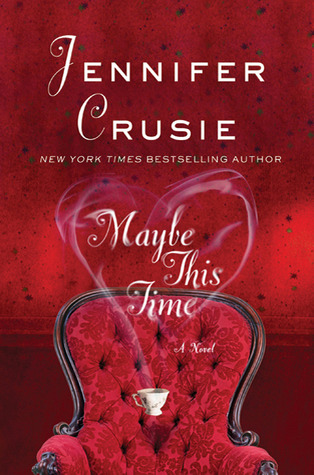
Summer Reading 2 – Maybe This Time by Jennifer Crusie

Summer Reading 2
Maybe This Time
by Jennifer Crusie
         
It’s been a long time since I was first introduced to Jennifer Crusie.  I remember  a friend being extremely enthusiastic about the latest Jennifer Crusie and Bob Mayer book.  I tried one and didn’t really care for it.  The collaboration just didn’t work for me.  (I tried their latest, Wild Ride, and it still doesn’t.)  However, if you’re looking for a quick, fun, romantic read then I highly recommend books written by Jennifer Crusie, on her own.
 
I remember reading Anyone But You several years ago - Nina Askew doesn’t think it would be appropriate for her to date the young ER doctor downstairs but her beagle/bassett mix, Fred, obviously does.  It was a fun, light, read.
 
I rediscovered Jennifer Crusie recently and devoured several of her books in just a week.  Trust Me On This has Dennie chasing the biggest story of her career while Alec is a Federal agent after a con artist.  It’s a case of mistaken identity and intentions that makes for anguish and laughter.
 
Bet Me was a delightful and incredibly funny, sweet and sexy book. Minerva Dobbs is a bit off beat but very practical.  Her logical choice for a boyfriend dumps her and a bet pairs her up, rather angrily at first, with Calvin Morrissey.  They part ways after dinner, intending not to see each other again, but something keeps drawing them back together.  I loved this one.
 
The most recent book I read was Maybe This Time.  I’ve always enjoyed ghost stories and this falls into that category as well as romance. 
 
Andie shows up at her ex-husband, North’s office, wanting nothing more than to hand back the alimony checks he has been sending every month for nearly ten years.  She never wanted the money and she’s ready to move on so she intends to cut her last ties with him.  She’s planning to get remarried.
 
North, much to his own surprise, asks for her help.  Two years ago he became the guardian to two children when his cousin died.  He left the children with their aunt but she has since died.  North has sent several Nannies but each one has come running home with her tail between her legs.  He offers Andie ten thousand a month to spend a few months with the kids, bring their education up to par and bring them home.  Andie won’t even have to contact him, they can communicate through his secretary.
 
Andie agrees to one month.  Ten thousand dollars would get her out of debt before she gets married.  She leaves, “before he could say or do anything else that made her forget she was done with him.”  Of course, it isn’t over until it’s over.
 
With so many books written by herself and several more with co-authors, it will take you a good little while to run out of reading material.  They are just plain fun.

Thursday, July 4, 2013

Summer Reading - The Last Original Wife by Dorothea Benton Frank


The Last Original Wife
By Dorothea Benton Frank
 
Dorothea Benton Frank has become one of my favorite authors for summer reading. She came to my attention over 10 years ago when my sister shared the first Lowcountry novel, Sullivan's Island. Part mystery, part Chick Lit, it introduced the author's main setting and theme – the Lowcountry of South Carolina and a woman in her prime facing a life changing circumstance of some kind. The woman typically heads home, to the Lowcountry, to find the emotional fortitude to face her situation.  The Lowcountry of South Carolina is also often reflected in the titles– Sullivan’s Island, Plantation, Isle of Palms, Pawley’s Island, and Folly Beach.

Leslie Anne Greene Carter is the main character of Frank's latest novel, The Last Original Wife. An unusual facet of this novel is that it's told in alternating chapters from Leslie and her husband, Wesley.  It is heavily weighted toward Leslie’s point of view but we also get Wesley's point of view and get to see how it changes over the course of the book.  Wesley may be "the bad guy" but he's not a totally bad guy and he grows over the course of the novel, just as Leslie does.  Unfortunately for the marriage, they are growing apart.

The novel starts out at the offices of a high priced therapist in Atlanta where a woman begs Leslie to sell her Leslie’s time with the therapist after finding her husband in bed with two of his daughter’s teenage friends.  Leslie tells her she can have the session if Leslie can have the name of the woman’s plastic surgeon and, by the way, divorce the bastard.  “Take all his money.  Every last nickel.  None of that divide by two bullshit.”  They exchange cards and the woman decides she doesn’t need the session after all.

Leslie and Wesley's own inciting incident is a vacation to Edinburgh, so Wesley can play golf, where Leslie ends up falling through an open man hole while taking pictures.  Wesley doesn’t notice until twenty minutes later when he gets back to the hotel with his friends.  Wesley blames Leslie for her accident and Leslie is angry at Wesley for leaving her alone in the hospital with his friend’s new young wife while he goes golfing. I suppose if falling in a manhole and breaking your teeth and arm as well as gaining numerous cuts and bruises while your husband walks on doesn't wake you up, then nothing will.

Leslie decides it's time to take an extended vacation down to see her brother, Harlan, in Charleston. There she reconnects with an old flame, and reads up on Josephine Pinckney, who owned the house where Leslie's brother lives. She is called home when Wesley is diagnosed with cancer and she agrees to go take care of him during his biopsy surgery. Wesley tries to convince her to come home permanently and the novel comes full circle to visit the therapist we saw in the beginning.

This novel is sort of like a gossip session with girlfriends that you don't have to feel guilty about because the characters only exist in the book. There's a lot going on. Light, but not too light, a perfect summer read. Enjoy!

Friday, June 21, 2013

A Young Girl's Favorite Books

I've noticed a lot of lists with books for girls on Pinterest lately and it got me thinking about my favorite books growing up.  This is just a quick list of some of my favorites when I was young.  

As I thought about the books I would want to include, I realized there were five main ways I found these stories.  They were either books we had at home, books at my grandmother's house, books teachers and librarians read to us at school, books I found in the school library, books I found in the public library or books I learned about because the families I babysat for had them and read them to the kids at bedtime.

Here's a few of my favorites - 

The Country Bunny and the Little Gold Shoes by DuBose Heyward and Marjorie Flack -  This is one of my daughter’s current favorite books.  I gave it to her for Easter and she has wanted to read it regularly, insisting on it migrating from her bedroom to the downstairs and back up at night.  We had a copy when I was a child.  I always remembered it but couldn’t think of the title.  Then I worked with an amazing children’s librarian a decade ago and started describing it to her, or at least what I could remember.  She recognized it instantly and told me it was probably the best Easter book for children ever written.  It was surprisingly ahead of the times back in 1937.  The Country Bunny is a single mom with 21 children.  She always wanted to be an Easter Bunny but she had children and life got away from her.  Now her children are a little older and she has honed all the skills Grandfather Bunny is looking for in an Easter Bunny while raising her children. 


Bobbsey Twins in Rainbow Valley by Laura Lee Hope  – This was a little book that I found in my grandmother’s house and I loved reading it every time I was there.  The two sets of twins, Flossie and Freddie and Bert and Nan, go on vacation with their parents to Rainbow Valley.  Many mildly scary adventures befall them on their trip.  I think the adventure on vacation angle appealed to my mind because I was on vacation at my grandmother’s house.  I read once that kids are naturally fascinated with twins and I certainly was.


The Little House on the Prairie series by Laura Ingalls Wilder – There’s something about reading a book while you’re sick that makes it more vivid and that’s how I read these books as a child.  They were wonderful, simple, stories.  I think my favorites were The Little House in the Big Woods, On the Banks of Plum Creek and By The Shores of Silver Lake or even The Long Winter.  Oh, I loved them all.  I was always avidly interested in history, partly because my grandmother lived in such an old house.  These stories often related to things I had seen at my grandmother's house, like old tools and cooking implements.  I can’t wait to share them with my daughter.


The Fire Cat – This was one of my favorite books when I was little.  We had a copy at home and I’ve never forgotten it.  I've seen it here in the library a number of times and just saw a new copy being added to the system.  Who wouldn't love a cat named Pickles?  It's a true adventure with a cat who has too much time on his paws.  Mrs. Goodkind adopts brings him into her home but before you know it he is up a tree and she has to call the fire department who save, adopt and redeem this troubled cat. 


The Secret Garden by Frances Hodgson Burnett - I think my recollections of this story could be a little bit mixed up with the movie at this point but I still remember the soft green of this paperback copy and the softness of the pages for some reason.  The story never got old for me.  Mary is an orphan after her parents die of Cholera in India.  She is frail and sickly but when she goes to stay with her uncle on the moor in England, the garden she finds helps her return to health even as she helps it.  There's another secret in the house that Mary brings to light as well.  I bought a big hardcover copy of this book some years ago, hoping I would have a child to share it with eventually.  My mother found it and read it just a few years ago and I think she enjoyed as much as I ever did. Who wouldn't like a little bit of Earth to call their own? And how much better if it's a secret garden with a hidden door in a high wall?  It's the magic of nature.


Little Women by Louisa May Alcott – Meg, Beth, Jo and Amy are being raised by their mother, Marmee, while their father is away as a chaplain during the Civil War.  Really, reading the summary of this book, one might not think it a book for a young girl, but it is a wholesome story and appropriate for any age that can read it, I think.  Perhaps because this book grew out of Alcott's own childhood, it seems to ring with truth.  There are some tremendously high ideals and philosophies shared in this lovely story, as when Marmee tells the girls, "Money is a needful and precious thing,--and, when well used, a noble thing,--but I never want you to think it is the first or only prize to strive for. I'd rather see you poor men's wives, if you were happy, beloved, contented, than queens on thrones, without self-respect and peace."  I also enjoyed Little Men and Jo’s Boys, but not like the first one.


Chronicles of Narnia: The Voyage of the Dawn Treader - I don't remember when I first read one of the Chronicles of Narnia but I know that by the time I left grade school, I had bought my own little paperback boxed set of the books because I loved them so much.  The Voyage of the Dawn Treader take Lucy and Edmund back to Narnia with their unpleasant cousin, Eustace.  They end up on a ship with their old friend Caspian, now King and go on a voyage with him to find the seven lost lords of Narnia.  This isn't a simple or easy tale but a journey worth taking.  I've enjoyed all the other books in this series too.  The Silver Chair is the first book in the series that I read and the gloomy character of Puddleglum, the Marshwiggle, will always hold a special place in my heart.    


A Wind in the Door by Madeline L’Engle - This is actually book two in a series but it is my favorite, perhaps because I read it first.  Fall in New England is one of my favorite places and seasons, which makes the setting perfect in this book.  Meg is worried about her little brother, precocious Charles Wallace, and her fears are confirmed when it is revealed that there is a war of good and evil being waged in Charles Wallace's mitochondria.  She and her friend Calvin must travel into microscopic space to save Charles Wallace.  Really, the other two books, A Wrinkle in Time and A Swiftly Tilting Planet are just as good but I think the budding romance in this one appealed to me as a young teen.


The Dark is Rising by Susan Cooper – This is one that I re-read every few years.  I was introduced to this series, and in particular this book, because I was babysitting for a family who was reading a chapter every evening at bedtime.  On his 11th birthday, also Midwinter day, Will Stanton awakes to a rarity where he lives, it is snowing, heavily.  The silence that envelopes the countryside is eerily reflected in his own house as no one will awake.  Will goes to find out what is happening and learns that he is the last of the old ones, born to stop the dark from rising.  It is not only beautifully written and enthralling from the beginning.  I was hooked and the mother lent it to me when they were finished.  I eventually bought my own copy.  It is still one of my favorites and I re-read it periodically.  There is another book which comes first in the series, Over Sea, Under Stone, but you've no doubt noticed that I don't necessarily read a series in order.  I go for whatever is available. This is still my favorite in the series.


The Mystery of the Crimson Ghost by Phyllis A. Whitney – Like most teen girls, I was horse crazy. Of course, it didn’t help that I grew up on the same street where they held horse auctions every other Friday and I walked horses to cool them down after polo matches one year.  I spent years trying to find this book again because I didn't have the title quite right.  I finally ran across it and found out it was by none other than Phyllis Whitney.  This was the perfect story for a horse crazed teenager with a love of mysteries.  Janey goes to visit her Aunt Viv on summer vacation and sees a mysterious crimson ghost dog across the lake.  There's also a beautiful horse across the lake.  in order to ride the horse, she'll have to figure out the mystery surrounding the crimson ghost.  

Please feel free to add some of your favorites in the comments.  I always love to hear about books I missed and I’m looking forward to reading a lot of books with my own daughter.

Friday, June 7, 2013

19 Varieties of Gazelle by Naomi Shihab Nye


19 Varieties of Gazelle: Poems of the Middle East
By Naomi Shihab Nye

If you don’t know the poetry of Naomi Shihab Nye, I recommend you give her a try.  This collection of poetry is much like the author, a blending of her Palestinian ex-pat. father and her American mother, sharing her great love of both places. 

It made me think about a very quiet and kind man I had known when I worked for a utility company who spoke of how beautiful the country in the Middle East where he was born is.  He clearly loved that place but I had the distinct impression that he never expected to see it again.  I wondered if he couldn’t go back for political reasons, but I was too shy to ask such a personal question.

This book was published the year after 9/11, and that event affected her deeply, as it did all of us, but somewhat differently than myself.  This book shares the authors feelings and thoughts beautifully.

“September 11, 2001, was not the first hideous day ever in the world, but it was the worst one many Americans had ever lived.  May we never see anther like it.  For people who love the Middle East and have an ongoing devotion to cross-cultural understanding, the day felt sickeningly tragic in more ways than one.”

There is humor and beauty in the collection, as well as the sadness and gravity.

from My Father and the Figtree

“Years passed, we lived in many houses,
none had figtrees,
We had lima beans, zucchini, parsley, beets.
“Plant one!” my mother said,
but my father never did.
He tended garden half-heartedly, forgot to water,
let the okra get too big.
“What a dreamer he is.  Look how many
things he starts and doesn’t  finish.”

The last time he moved, I had a phone call,
my father, in Arabic, chanting a song
I’d never heard. “What’s that?”
He took me out to the new yard.
There, in the middle of Dallas, Texas,
a tree with the largest, fattest,
sweetest figs in the world.
“It’s a figtree song!” he said,
plucking his fruits like ripe tokens,
emblems, assurance
of a world that was always his own.”

It was as if he had to find the tree, rather than planting it himself.

Speaking of her father in the introduction, the author says, “he was a regular customer at the local drugstore soda fountain in his new little town.  ‘He always looked dreamy, preoccupied, like he could see things other people couldn’t see,’ the druggist told me twenty-five years later.  Well yes, I thought.  That’s what immigrants look like.  They always have other worlds in their minds.”

It is Spring here and we watch the rain fall and nourish the new seedlings so that the heat makes them take root and shoot upward.   Perhaps that is why this next poem caught me.

from The Garden of Abu Mahmoud

“He said every morning found him here,
before the water boiled on the flame
he came out to this garden
dug hands into earth, saying, I know you
and earth crumbled rich layers
and this result of their knowing –
 a hillside in which no inch went unsung.
His enormous onions held light
and the trees so weighted with fruits
he tied the branches up.

And he called it querido, Corazon,
all the words of any language
connecting to the deep place
of darkness and seed.  He called it
ya habibi in Arabic, my darling tomato,
and it called him governor, king,
and some days he wore no shoes.”

Her message seems simple, but difficult in this world, peace.  I think it must come from communication and this line caught me in that thought.

from Arabic Coffee

“stay, be seated, follow the talk
wherever it goes.”