Friday, March 29, 2013
The Joy Diet: 10 Daily Practices for a Happier Life by Martha Beck
The Joy Diet: 10 Daily Practices for a Happier Life
By Martha Beck
This morning I was at a workshop focused on recognizing and coping with stress. Many of the strategies that I use came out of this wonderful little book by Martha Beck and then it occurred to me that I hadn't done a book review of it here.
Several years ago I picked up the book The Joy Diet: 10 Daily Practices for a Happier Life by Martha Beck. It's a tiny little book but it holds so much humor and wisdom. I incorporated it into my life at that time and it truly helped me put what was most important to me center stage in my life, define goals and take towards making it a reality. I still do a few things she recommends on an regular basis but I think working more consciously with all these steps could be just what I need in my life.
One of the hardest steps, though it sounds easy, is the first - to do fifteen minutes of NOTHING every day. We are so inundated with things to do that it may be more difficult than you think to find fifteen minutes all to yourself to quiet your mind. Of course, you can never really completely quiet your mind. The point is to watch your thoughts go by without getting drawn into the emotions they usually create. My boss is being a real jerk today! Mmm-hmm, that's nice dear. Just watch your thoughts float by like a leaf floating down a stream. The point is to detach from them so you can relax. I found doing this on paper, ala Julia Cameron's "Morning Pages" was a great way to go for a writer.
The second step is to create or find a moment of TRUTH every day. We tend to assume that the things we are telling ourselves are true. The truth may be vastly different and yet those thoughts are creating our feelings! We dig a little deeper to find the truth so that we can be more productive. I have felt my mood elevate just by acknowledging what I am saying to myself and recognizing how I have made something seem worse than it really is.
The third step is to figure out what we DESIRE. So many times we divorce ourselves from what we really want in our lives because we think it just isn't realistic, that we're never going to get it. "I'll never find someone to love so I should just stop wanting it." But that doesn't make the desire go away, it just submerges it so that it becomes a deep-seated source of discontent. Might as well acknowledge what we want, figure out if it's something we really want, then start figuring out how to get it. Which brings us to our next step.
CREATIVITY. Most of the time we're not going to get what we really want by doing the same old things we've always done. It's time to get creative and come up with some ideas. Martha has a phrase for it that I really like, "force innovation." You create lists of ways to get what you want, from reasonable to illegal. The point is to brainstorm ideas, not necessarily to do them.
Next comes RISK. It's often going to take a risk to get what you really want. If you break it down into the smallest step you can possibly take every day, you can overcome the fear and actually take the step. Put up the profile on the dating site, send the manuscript to the editor, send your resume off to the company.
Then you can get to the TREATS. Just like training any lab animal, you're going to have to reward yourself into taking action if you're going to keep it up. Martha teaches you how to figure out what a treat is for you and to give yourself permission to have them. (Yes, some people need permission to treat themselves well.) Some of mine include listening to music, petting my cat and good coffee. It's anything that sparks a smile for you. The real trick is to recognize them as treats and take full pleasure in them.
The ability to PLAY is something most of us figure we have to give up at some point. What Martha is suggesting is a change in perspective about what you do every day. Once you realize what your purpose is in life, you can see that everything else you do is simply a game you are playing to make your real purpose in life possible. It's not such a big deal. Martha has a shortcut to figuring out what your purpose is. Think about September 11, 2001. What did you do that night? It's probably related in some way to your life purpose. I wrote a fictional story about a woman who lost her husband in the towers, but then I've always known my purpose is to write. Yours may not be quite so literal.
Ever since Norman Vincent Peale, we've all known that LAUGHTER is a powerful form of medicine. Really, is there anything better for lifting your mood? Sometimes I trip over it and sometimes I have to go looking. I take myself over to Pinterest and look at the Geek board at least every other day. I adore funny movies and books. I recently found the Sweet Potato Queen books and I have not laughed so hard at a book in ages. It relieves stress and lowers your blood pressure. I'm learning to laugh instead of getting angry when something goes wrong. Martha suggests you should be getting at least 30 LPDs (Laughs Per Day.) I'd say it's a fun thing to strive for.
CONNECTION is perhaps the most important of the Joy Diet steps. It requires that you use the first five steps in dealing with at least one other person every day. We all know that solitary confinement is a punishment. There's a vast difference between being alone with yourself and being lonely. We need other people in our lives, but more than that, we need to feel connected to other people. A lot of people don't know how to truly connect with others, or they're afraid of the pain that doing so will inevitably bring them.
Yes, being connected to other people will bring you pain. They will do things that hurt you or you might be left behind at some point. The point is that by being connected to other people, you'll be better able to endure the pain life throws your way. Martha says that, "even as your heart breaks, you'll find that it always breaks open." You'll have a network of connections to call on in your time of need.
The last step simply sounds joyful, FEASTING. I close my eyes and picture large groups of people talking and laughing, sitting around and enjoying each other's company, with music and food and drink. But feasting doesn't require other people. It doesn't even require food. Feasting is about the attention you give to whatever activity you are engaging in so that it is set apart from other daily activities. One of the most important aspects of feasting is ritual. Most people think of a church service or a family saying grace before dinner, but it can also mean getting into comfy clothes, making popcorn, and getting cozy on the sofa with a blanket before starting a movie. The actions set what you are about to do apart from the rest of the day.
You can feast on sights, sounds, touch, movement or even sleep. It's something that feeds you physically, emotionally, intellectually or spiritually. Some of my favorite feasts involve watching a movie that inspires or makes me think, listening to peepers in the warm spring air late at night or washing my hands in warm water with honey scented soap. Then you give thanks. Feel your gratitude for this feast, whomever you direct it to, God, the universe or yourself. Being grateful for the good things gives us something to hold onto when things aren't going so well.
Of course, there's a lot more to all of this than I've been able to say in just this post but I hope it gives you the idea. This little book is packed with humor and information. Just reading it is a feast and will help you get your laughs for several days. I've only been able to give you a taste here. I highly recommend you get the book for yourself and give it a try. Check it out at the library if you're not sure you want to spend the money on it. I did, and ended up buying it for myself. I'm so glad to have it on my bookshelf. I hope it enriches your life too.
Friday, March 15, 2013
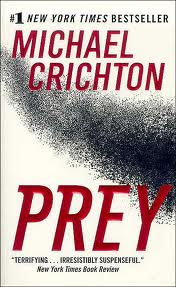
Prey by Michael Crichton
Prey
By
Michael Crichton
Jack has been a stay at home dad for the
last few months, ever since he got fired for exposing inappropriate behavior at
work in a superior. He has three kids
but don’t feel too sorry for him, he still has a housekeeper. His wife, Julia, is working a lot at the
company, Xymos, where she’s a vice-president and has begun acting
strangely. Is it just the stress, or
something else?
Julia comes home one night and the baby
is soon sick, turning a bright red and screaming. Jack takes the baby to the emergency room
where they can’t find a cause but during an MRI the machine breaks down and the
baby’s symptoms simply go away. The next
day the baby looks bruised but is completely happy.
Julia’s strange behavior continues, even
staying out all night without calling home.
She accuses Jack of undermining her with the children and he fears they
are headed for a divorce when she is in a car accident.
Just before the accident, Jack’s former
place of work calls him to see if he will come back to work because they are
having trouble with a program he created which they contracted to… Xymos.
Jack takes the job. He needs the work and he needs to know what
has been happening out at the fabrication plant, where Julia has been spending
so much of her time.
Crichton is a well-known author, from
his first bestseller, The Andromeda Strain,
to his last novel, Micro, finished after
Crichton’s death by Richard Preston. Crichton
was a well-known producer, director and screenwriter. He held a degree in anthropology and a
doctorate in medicine, and is best known for cautionary scientific tales.
Crichton often focused on the
exponential growth of technology, how things are changing faster and faster,
and the lack of human understanding and caution in dealing with those evolving
technologies.
His writing is often classified as techno-thriller. The books are simple story lines, fast paced
and rely on quite a bit of scientific explanation to make them
interesting.
Prey was my first Crichton novel and I will definitely
read and listen to more on CD. I would
recommend them to anyone who enjoys an interesting tale told at a fast pace,
extrapolating from scientific facts and asking “what if?”
Friday, March 1, 2013
Homeless Bird by Gloria Whelan
Homeless
Bird
By
Gloria Whelan
Koly
is only thirteen when her parents manage to scrape together a dowry and arrange
a marriage for her to a young man, Hari.
Her father is a man of words, writing letters for others who do not know
how, but it pays little. There is simply
not enough food for everyone in the family.
Her
Maa and Baap arrange a marriage for her and take her to her new family’s
village, but Hari is younger than they were told and very ill. The marriage was only arranged so Hari's parents
could use the dowry money to take their son to the Ganges, hoping
for a miracle cure.
When
the boy dies, Koly becomes little more than a servant in the house to her
shrewish mother-in-law. Life is
difficult but her new sister-in-law and her father-in-law are very kind to
her. He actually teaches her to read. When he dies of a heart attack, though, her
mother-in-law takes her to the city of widows, Vrindavan.
After,
a few long days and nights, Koly is lucky to be given a place in a home for
widows and a job stringing marigolds.
Her talent for embroidery, learned from her mother, enables her to build
an even better life for herself and, eventually, the young man who falls in
love with Koly.
Gloria
Whelan captures the voice of Koly beautifully and tells an intriguing but
simple tale in this book. It provides a
window into a changing world, where one young woman uses her talents and a bit
of luck to thrive.
I
will admit that this is a young adult book, it won the 2000 National Book Award
for Young People’s Literature, but I highly recommend it for anyone interested
in an easy way to learn about an aspect of another society. It is a quick read filled with beautiful
prose and a little romance.
Friday, February 22, 2013
Moses, Man of the Mountain by Zora Neale Hurston
Today's Story Musing entry is
guest written by Maryalice Little of the Southeast Steuben County Library.
Moses, Man of the Mountain
by Zora Neale Hurston
After being
introduced to Zora Neale Hurston’s Their Eyes Were Watching God, I
wanted to enjoy more of this author’s rich use of descriptive language. I
read her next work, Moses, Man of the Mountain, and I became even more
impressed by the writings of Hurston (1891 - 1960).
In Moses, Man of the Mountain, Hurston retells the story of Moses, who, though born of humble lineage, is raised as royalty. After rejecting his privileged position, he spends years in another land then he returns to lead his people away from their hard, but familiar, lives of bondage in Egypt to a life of self-government in a new land.
Hurston’s writing
style breathes humanity into familiar characters with insightful descriptions
of their thoughts and actions. Her writing style integrates the Biblical
story of Moses with the legendary tales of Moses from Africa and the West
Indies; it encourages the reader to appreciate the humanity that surrounds
Moses’ power--because his power “does not flow from the Ten Commandments.
It is his rod of power, the terror he showed before all Israel and to Pharaoh,
and THAT MIGHTY HAND.” ---from the author’s introduction to Moses,
Man of the Mountain
In this version,
Moses is described as being a very curious child, and it was “the gardeners and
the grooms who caught his attention....There was one old man who tended the
horses. He had answers in the form of stories for nearly every question
that Moses asked and he told stories unasked because they just came to him to
tell.” So Moses gained a foundation of knowledge and wisdom about the
ways of the world.
As Moses grew into
manhood, he was relegated to learning the ways of the military, as his elder
brother would someday become the reigning Pharaoh. His aging mentor
advised him to learn to fight on horseback, not in chariots, as his elder
brother did. Moses learned strategy by listening to the men of war and by
experimenting with maneuvers. “There was something about him, outside of
being the grandson of Pharaoh, that made men listen to him with respect.
There was something about him that assured them he was a companion to be relied
on in times of danger. They wanted to follow him into any escapade he
thought up. He was the young men’s choice for a leader.” And so
they came to beat the Pharaoh’s “finest chariot force in the world” at the
bi-annual military maneuvers.
These experiences
and qualities served Moses well when he struggled to lead his people to a new
way of thinking and a new homeland. Negotiating with Pharaoh to let his
people go required strategy, inspiration, patience, understanding, and perseverance.
The forty years that they would spend in the wilderness were not just about
traveling a geographical distance, but also about learning a new way to think.
Moses understood this. In their first battle along their journey, Moses
answers, when his young assistant, Joshua, questions whether the men will
follow his lead, “Young or old men will follow you if you got that something to
make ‘em willing. You are going to be one of the great men at arms, watch
my word. This will be good practice for you and it will be good for the
people. Once they win a battle, it will tend to lift up their
heads. Now they are scared of everything and they think nothing is scared
of them. They need to win something.” And they did.
Again and again,
the people say that they want freedom but act in ways that indicate that they
are reluctant to let go of their past dependencies. And, again and again,
Moses consults with his God of Sinai and leads the people onward to their new
life in a new land.
Zora Neale Hurston
tells this ancient story in a rich language that brings compassionate insight
to the timeless journey of humanity.
Maryalice K.
Little
Friday, February 15, 2013
Their Eyes Were Watching God by Zora Neale Hurston
There’s something about having
to read a book that makes me not want to, no matter how good the book is. I put off reading Their Eyes Were Watching God by Zora
Neale Hurston for as long as I could because it was chosen for our Community
Read. Finally, running out of time, I
got the book on CD, performed by Ruby Dee, and listened to it in the car on the way to
work and home again.
I fell in love with it.
I would take this book any day over Romeo and Juliet. (I do like Shakespeare. I just don’t consider R&J much of a
romance.)
The over arching theme in this book, for me, is Janie’s
search for love. She is searching not
just to find love for herself but to find out what love is.
The book begins as Janie returns to Eatonville one evening,
having been gone with Tea Cake for some two years, and tongues begin to wag as
people watch her pass.
“It was the time for sitting on porches beside the
road. It was the time to hear things and
talk. These sitters had been tongueless,
earless, eyeless conveniences all day long.
Mules and other brutes had occupied their skins. But now, the sun and the bossman were gone,
so the skins felt powerful and human.
They became lords of sounds and lesser things. They passed nations through their
mouths. They sat in judgement.”
Only her friend Phoeby speaks up for her then goes to take
her some food and hear what has gone on.
Janie is annoyed with the busybodies.
“Now they got to look into me loving Tea Cake and see whether
it was done right or not! They don’t
know if life is a mess of corn-meal dumplings, and if love is a bed-quilt!”
Janie resolves to tell Phoeby everything that has gone on,
not just for the past two years, but to help her understand, she must go all
the way back to her childhood. The novel
encompasses decades and Janie is married three times over the course of the
novel. The first time her grandmother,
Nanny, marries her off very young to a much older man, concerned that Janie
have all the material things in life and protection that Nanny never had.
“Janie had no chance to know things, so she had to ask. Did marriage end the cosmic loneliness of the
unmated? Did marriage compel love like
the sun the day?”
As many women found out, though love could grow under the circumstances of an arranged marriage, there was no guarantee and Janie did not find love with her first husband, Logan Killicks.
Janie stays with him for a couple years but Nanny passes
away and with nothing other to hold her there, she is interested when Joe
Starks shows up and starts courting her.
She gives Logan
one last chance but he refuses the connection she offers and the next morning
Janie runs off with Joe, who she calls Jody.
They get married and head for a growing community Jody has heard of in
Florida, Eatonville.
Janie spends over 25 years with Jody but it isn’t the
marriage she had thought it would be.
Jody is more intent on having a trophy wife to stand by while he opens a
store and becomes mayor. He doesn’t want
Janie to speak her mind or even be seen too much. He even makes her cover her hair with a
kerchief so that other men can’t see or touch it.
Janie finally has her say when Jody is on his death bed, “Ah
run off tuh keep house wid you in uh wonderful way. But you wasn’t satisfied wid me de way Ah
was. Naw! Mah own mind had tuh be squeezed and crowded
out tuh make room for yours in me.”
Love itself can make a common ground for meeting on because
both people want to please one another and both have equal power to hurt one
another. But that requires a willingness
to connect and let it be seen. Logan
wouldn’t let it be seen in himself, he wanted her gratitude. Jody just wanted someone to obey him and love
him.
“…now you got tuh die tuh find out dat you got tuh pacify
somebody besides yo’ self if you wants any love and any sympathy in dis
world. You ain’t tried tuh pacify nobody
but yo’self. Too busy listening tuh yo’
own big voice.”
Jody dies and Janie finally has time and money and on one to
please but herself. Then Tea Cake starts
coming around. Theirs is a different
type of relationship from what Janie has experienced so far right from the beginning.
“He set it [the checkers game] up and began to show her and
she found herself glowing inside.
Somebody wanted her to play.
Somebody thought it natural for her to play. That was even nice. She looked him over and got little thrills
from every one of his good points.”
But the town doesn’t take so well to Janie taking up with
Tea Cake, who is 12 years younger. They
think it’s too soon and that he isn’t an appropriate person. So Tea Cake resolves that they need to start
fresh somewhere else. They go south to
work in the bean fields and Janie has never been so happy, until the hurricane.
It’s a tragedy, there’s no denying that. They only have two years together but Janie has more happiness in those years than in the last thirty. She has finally found love, figured out what it is, how it is different, and even learned to love herself.
"… love ain’t somethin’ lak uh grindstone dat’s de same thing everywhere and do de same thing tuh everything it touch. Love is lak de sea. It’s uh movin’ thing, but still and all, it takes its shape from de shore it meets, and it’s different with every shore.”
This short review cannot even begin to give you a sense of the beauty and breadth packed into this book. I hope you'll read it for yourself.
Thursday, January 31, 2013
Maisie Dobbs by Jacqueline Winspear
What many of my generation remember learning about the first World War could be summed up as –
1.
The assassination of Archduke Franz Ferdinand helped to touch it off.
2.
It occurred, roughly, during 1914 to 1918 3. Snoopy was a World War 1 flying ace who flew a Sopwith Camel biplane.
Okay,
I didn’t know it was a Sopwith Camel until I looked it up.
I
find myself of two minds about the Maisie Dobbs series. There are many things to enjoy, but there are
aspects that bothered me. I would be
reading along and suddenly something would happen that would throw me out of
the story in consternation.
Let’s
start with the historical context which is, I think, the strongest part of this
book.
Winspear’s
paternal grandfather came back from WWI shell shocked, which might be referred
to as Post Traumatic Stress Disorder today, and with serious leg wounds. She said in one interview that he was
removing shrapnel from his legs for the rest of his life. His lungs were also damaged by gas. Her maternal grandmother was a munitions
worker in an arsenal, where she was partially blinded in an explosion that
killed several of the girls she worked with.
This
is a topic which Winspear is deeply attached to and her writing
shares her fascination with us. It has
led her to write 9 novels with the 10th on the way in March of this year.
Now,
who is Maisie Dobbs? Maisie is, in some
ways, an orphan because she lost her mother at a young age and then her father sent
her into service, admittedly for her own good.
She is highly intelligent and even attended Girton College
(Cambridge) though women were not allowed
to actually receive degrees at that time.
She is a former nurse, during WWI.
She is a private inquiry agent and a psychologist. She is also a bit psychic, which some people
may be able to enjoy but it really bothered me when it cropped up.
The
first novel, Maisie Dobbs, takes us along as Maisie opens her own office for
the first time, and she meets Billy Beale, a handyman who ends up helping her
with her office and eventually cases. He
remembers her as the nurse at the casualty clearing station in France during
the war 12 years before, who helped calm him while the doctor saved his leg and
his gratitude is heartfelt. As he
continually tells her, “You need anything done, Miss, Billy Beale’s your man.”
I
have read the complaint that at times, it seems as if there is too much detail
in the accounts, every movement and every bit of clothing described. I have felt that way myself, but as we see,
that is the way Maisie was trained by her mentor, Maurice Blanche, to
investigate.
“During
her apprenticeship with him, he had been insistent that nothing was to be left
to memory, no stone to remain unturned, and no small observation
uncataloged. Everything, absolutely
everything, right down to the color of the shoes the subject wore on the day in
question, must be noted. The weather
must be described, the direction of the wind, the flowers in bloom, the food
eaten. Everything must be described and
preserved.”
Maisie’s
first case independent of her mentor and former employer, Maurice Blanche,
arrives in the form of Christopher Davenham.
Davenham is concerned that his wife is having an affair.
Maisie
agrees to look into the situation, on the provision that when she presents her
findings, they will discuss it. She
feels a responsibility for what the ramifications of any information she
uncovers will have on the couple. It is
here we must remember that Maisie is not only a private enquiry agent, but also
a psychologist.
Maisie
sets out to follow the young wife, Celia.
“Maisie
copied the woman’s posture as she walked, and immediately felt her stomach
clutch and a shiver go through her. Then
sadness descended, like a dark veil across her eyes. Maisie knew that Celia Davenham was weeping
as she walked, and that in her sadness she was searching for strength.”
I
confess, this is a bit much for me. I
think that there is a lot to be said for observing someone’s posture, and even
copying it might help a detective think about what state of mind or body would
put someone in that posture, but this takes it a step beyond empathy or
intuition, to have her “stomach clutch and a shiver” run through her.
You
can hold a belief, you may even be correct, but the only way to know what a
person is thinking and feeling is to ask them and then trust that they are
telling you the truth and that they know their own mind. Anything else is conjecture. Just once I’d like Maisie to find out she’s
wrong. But of course, Maisie is nearly
always right.
Maisie
follows Celia to a cemetery in the town of Nether Green, where she places
flowers and weeps over a grave with asingle name, Vincent, engraved on the headstone.
As
Maisie learns more about Vincent and how he died, she pursues her own interest
in his death. Coincidentally, it seems
James, the son of Lady Rowan and Lord Compton, is thinking about moving to The
Retreat.
The
book now shifts back in time to the Spring of 1910 and moves forward from there
for 135 of the 295 pages of the book. It's rather unusual but, to my mind, the
best part of the book. She covers a
great deal of time in those pages, ending in the Spring of 1917.
We
are given a full look at Maisie's service ala the PBS series Upstairs
Downstairs.
Maisie
gets to visit her father on Sundays, her day off. On Wednesday's she is sent to
the public library to get books for the cook and butler, as well as herself,
but Maisie becomes fascinated by the books in the library at the house.
Fortunately,
or unfortunately, Lady Rowan catches Maisie in the library reading early one
morning after a late party. Maisie fears she is going to lose her job but Lady
Rowan has other ideas.
Lady
Rowan proposes to have Maurice Blanche tutor Maisie (though much of her
studying will have to be self-directed, as she already has been.)
Eventually,
Maisie is off to college and getting settled in her rooms when we are
introduced to one of my favorite characters, who will become a friend of
Maisie’s for years to come (throughout the series.)
“Suddenly
the loud crash of a door swinging back on its hinges, followed by the double
thump of two large leather suitcases landing one after the other on the floor
of the room next door, heralded the arrival of her neighbor. Amplified by the empty corridor, she heard a
deep sigh followed by the sound of a foot kicking one of the cases… Maisie
heard footsteps coming toward her room.
A fashionably dressed girl with dark chestnut hair stood in front of
her, and held out her finely manicured hand.
“Priscilla Evernden. Delighted to
meet you – Maisie Dobss, isn’t it?
Wouldn’t happen to have a cigarette, would you?”
Priscilla
eventually takes off to drive an ambulance in the war effort and Maisie decides
to enlist for nursing service.
She
is quickly sent to France and her experiences in training, travel, her post in
a clearing station for wounded, and being courted by a doctor are all depicted
sensitively and painfully at times.
Then
we are back in 1929, and to the mystery, delving right in with an explanation
of how James is suffering from his war wounds and considering moving to The
Retreat.
It’s
a bit of a long out take and while very enjoyable, has completely departed from
the flow of inquiry in a mystery. It’s
like we’ve had a book within a book.
Frankly, the stronger of the two books for me.
I
will say that the ending works for some but not for others. Suffice it to say, it involves singing.
Maisie
does bother me as a character a bit. The
character was created as a little too nice, a little too earnest – her only
flaws come from her trying too hard and being too good. I think this does get better in subsequent books but I have the feeling the author had trouble letting her character falter.
Is
this a novel or a mystery? If it is a
mystery series, are they cozy or detective fiction? What is the difference?
I
would say the first book is more a novel than a mystery. Subsequent books provide the reader with a
more strongly plotted mystery.
You
would think these books would be detective fiction since the main protagonist is a
private investigator but the clues are not all laid out for the reader. There are too many leaps in the process that
are put down to Maisie doing things in the background that the reader isn’t
privy to or letting her make leaps in deduction based on information she
learned in her past that we don’t have.
Simply too many coincidences and intuitions. It falls much better into the “cozy”
category, which generally means minimal references to sex, violence, foul language, drug
usage, etc.
In
summary, the Upstairs Downstairs type atmosphere is interesting and the author
is at her best when writing eloquently about what people suffered during and
because of “The Great War.”
The
mystery does get stronger in subsequent books, but it’s never the strongest
part of the book.
Read
Maisie Dobbs for the history, the relationships and the light, cozy mystery.
Friday, January 25, 2013
Code Name Verity by Elizabeth Wein
Code Name Verity
by Elizabeth Wein
Wow. I just finished Code Name Verity and I feel on the verge of crying again. I feel wrung out, like I just lived part of this with them.
I did not cry through most of the book, until I
got to the scene where the Frenchwoman treats one girl so kindly, and then
again when the author is describing how the children saw a classmate being
guillotined to death. It wasn't the fact of it, it was how she brought the
reality home in a way that was easy to relate to.
“...what if it had been my old friend Beryl? Or
Beryl's sister? Because that's what it's like, schoolmates being guillotined as
spies. I didn't understand before – really didn't understand. Being a kid and
worrying that a bomb might kill you is terrible. But being a kid and worrying
that the police might cut your head off is something else entirely. I haven't
words for it. Every fresh broken horror is something that I just didn't
understand until I came here.”
Fresh broken horror. Yes, there are
horrific things about this book, but they really happened to someone during
that war. They are made fresh and immediate in the first person voice and that
voice rings true. The first two- thirds of the book is told by one person and
the last third is told by another.
It’s hard to know what to say about a book like
this. I don't want to give much away
because I don't want to rob anyone of the experience that they would have in
reading it, but I must tell you something to let you know how good it was.
It begins with Verity in a Gestapo prison, during World War
II, having been caught as a spy. She has
been tortured and has agreed to give them information in exchange for her
written confession and knowledge. She is
giving them the sets of wireless codes and you will have no idea what that
means until you are three-quarters of the way through the book, but it’s
important, so keep reading.
This is a spy novel, remember that. People are never who they seem.
Verity is very flippant at times, gallows humor. “(About the paraffin, kerosene, whatever it
is. I do not really believe you have a
liter of kerosene to waste on me. Or do
you get it on the black market? How do
you claim the expense? 1 lt. highly explosive fuel for execution of
British spy. Anyway, I will do my
best to spare you the expense.)”
There's so much detail that brings the story to
life, even ones that have been smudged. Everything was plausible, and it was
clear the author did a great deal of research and that she loved her subject.
It was fantastic, truly.
There are things that some reviewers said they just didn’t
buy but when they elucidate, I hear them saying that it didn’t fit into their
stereotypical view of what a Nazi was or how they acted, such as Von Linden
letting Verity write out all this information. If you accept that people are individuals, who
were drawn into the Nazi war machine, then it begins to make much more sense.
The person who performed this book on CD (read
just isn't strong enough a word) was exceptional. Even now, as I go back to
read a passage or two at the beginning, I can hear Verity’s Scottish accent,
light at times and stronger when she’s angry.
As a writer I felt I learned something about the
craft in this book. How clearly the voice of the character, not the writer,
comes through. That is what to strive for.
I don’t think I can recommend this book strongly
enough. Every book is not for every
reader but this one was definitely for me.
I hope it is for you too.
Subscribe to:
Posts (Atom)